What's New
Weather Stations Update
Originally deployed in 2012, thanks to funding from the West Coast Inland Navigation District (WCIND) through a grant from Lee County, the RECON weather stations became the first weather stations in this area located directly over the water. Designed to give researchers and boaters near real-time information on the current over water weather conditions, they quickly became the go to weather source for the local boating community. ...
Read moreThe River, Estuary and Coastal Observing Network (RECON) is a network of water quality sensors deployed throughout the Caloosahatchee river and estuary to provide real-time, water quality data to scientists, policy makers, and the general public.
The extensive watersheds of the Caloosahatchee (1,400 square miles) and Lake Okeechobee (4,400 square miles) each contribute water that flows into the Caloosahatchee estuary and the Gulf of Mexico. Water quality is affected by both Lake Okeechobee discharges and runoff from the Caloosahatchee watershed. Over time, these watersheds have changed from low-nutrient loading marshes and wetlands to high loading urban and agricultural land uses. Nutrients increase turbidity and decrease concentrations of dissolved oxygen (DO). In addition, excess nutrients fuel nuisance algal blooms. Losses of low-nutrient adapted communities, such as seagrasses have contributed to changes in fish, crustacean and marine mammal communities.

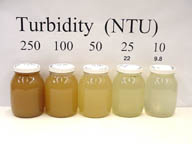 Turbidity is a measure of the ‘cloudiness’ or ‘opacity’ in appearance of fresh, estuarine or seawater caused by suspended particles in the water column. Its measurement provides an indication of the ‘clarity’ of water and thus water quality. Suspended particles cause light to be scattered and absorbed rather than transmitted in straight lines through the water. Particles may include clay, silt, fine inorganic and organic matter, soluble colored organic compounds, and small microscopic organisms.
 High turbidity also impacts biological organisms. Human-induced resuspension-turbidity effects often result from large-scale dredging operations to remove or redistribute sediments, ship and boat traffic, and land runoff. Observed effects are typically site specific as a consequence of sediment grain size and type, hydrological conditions, faunal influences, currents, water mass size and configuration, etc. Potential effects of turbidity and sediment resuspension have received a great deal of attention due to runoff and sediment dredging concerns. High turbidity can for example affect the eggs, larval, juvenile and adult fishes and shellfish in aquatic ecosystems.